News
-
Upgrade Django to 5.2.7
Fri - 24 Oct 2025 - 08:22
-
Upgrade Django to 5.2.3
Fri - 13 Jun 2025 - 13:15
-
Upgrade Django to 5.2
Wed - 23 Apr 2025 - 15:13
-
Upgrade Django to 5.1.2
Mon - 04 Nov 2024 - 20:15
-
Upgrade Django to 5.1
Fri - 09 Aug 2024 - 12:31
-
Upgrade Django to 5.0.8
Wed - 07 Aug 2024 - 12:58
-
Upgrade Django to 5.0.6
Wed - 22 May 2024 - 19:59
-
Upgrade Django to 5.0.1
Mon - 15 Jan 2024 - 10:27
-
Upgrade to Django 5.0.0 and Python 3.12
Tue - 05 Dec 2023 - 07:07
-
Upgrade Django to 4.2.6
Fri - 06 Oct 2023 - 16:20
-
Upgrade Django to 4.2.5
Mon - 04 Sep 2023 - 19:08
-
Upgrade Django to 4.2.4 and Python 3.11
Wed - 02 Aug 2023 - 16:46
-
Upgrade Django to 4.2.2
Wed - 07 Jun 2023 - 20:19
-
Upgrade Django to 4.1.2
Tue - 01 Nov 2022 - 18:32
-
Upgrade Django to 3.2.4 and use Django Jet Admin
Wed - 23 Jun 2021 - 16:17
-
Welcome on Ozon !
Fri - 05 Aug 2011 - 01:28
What is Ozone?
Ozone is a colorless gas. Chemically, ozone is very active; it reacts readily with a great many other substances. Near the Earth’s surface, those reactions cause rubber to crack, hurt plant life, and damage people’s lung tissues. But ozone also absorbs harmful components of sunlight, known as “ultraviolet B”, or “UV-B”. High above the surface, above even the weather systems, a tenuous layer of ozone gas absorbs UV-B, protecting living things below.
What is a Dobson Unit?
The Dobson Unit (DU) is the unit of measure for total ozone. If you were to take all the ozone in a column of air stretching from the surface of the earth to space, and bring all that ozone to standard temperature (0 °Celsius) and pressure (1013.25 millibars, or one atmosphere, or “atm”), the column would be about 0.3 centimeters thick. Thus, the total ozone would be 0.3 atm-cm. To make the units easier to work with, the “Dobson Unit” is defined to be 0.001 atm-cm. Our 0.3 atm-cm would be 300 DU.
What is the Ozone Hole?
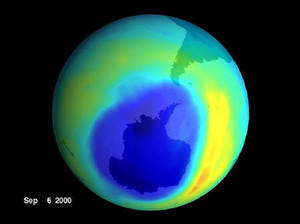
Each year for the past few decades during the Southern Hemisphere spring, chemical reactions involving chlorine and bromine cause ozone in the southern polar region to be destroyed rapidly and severely. This depleted region is known as the “ozone hole”.
The area of the ozone hole is determined from a map of total column ozone. It is calculated from the area on the Earth that is enclosed by a line with a constant value of 220 Dobson Units. The value of 220 Dobson Units is chosen since total ozone values of less than 220 Dobson Units were not found in the historic observations over Antarctica prior to 1979. Also, from direct measurements over Antarctica, a column ozone level of less than 220 Dobson Units is a result of the ozone loss from chlorine and bromine compounds.